
Big Idea
AI sounds confident, but confidence is not the same as accuracy. Students must understand that AI doesn’t know the truth - it just predicts what sounds true.
AI Is Not A Search Engine
I’ve watched hundreds of students use AI.
I’m not exaggerating when I say that 90% of them just use it like Google.
(Except, with every search, they get told what an “excellent” question they’ve asked.)
They think it works the same way as Google - type a question, get an answer, trust the result.
And that gets them into trouble.
Google searches the internet and retrieves information that real people have written. AI doesn’t do that. It doesn’t “look up” answers. It generates them. Every sentence is a new creation, based on patterns it has learned from vast amounts of data.
That means it can look right, feel right, smell right, and be wrong.
Looking Under the AI Hood*
Let’s think about what’s actually going on when we use a tool like ChatGPT.
ChatGPT - and other similar tools - are built on large language models (LLMs).
These models are trained on a massive amount of text from books, websites, and online conversations. Through this training, AI learns the statistical relationships between words - what words are likely to follow others, how ideas are commonly linked, and how sentences usually flow.
So when you ask a question, AI doesn’t search for a pre-existing answer. It calculates the most probable response based on the patterns it has seen before. It’s not looking up information - it’s predicting language.
Why draw out this technical point?
Because it means that AI can sound right while being completely wrong.
It can blend true and false information in ways that even teachers can miss if they aren’t careful.
And here’s where the rubber hit’s the road:
All information from AI must be verified and audited.
*in Australia we call the hood a bonnet, but, having googled bonnet this means a totally different thing outside of Australia! Although, come to think of it, perhaps it works too…
Treat AI like Wikipedia
I encourage my learners to treat AI like Wikipedia.
Wikipedia can be an excellent starting point.
It helps you understand an idea, see how it’s structured, and identify patterns and keywords. But we don’t quote Wikipedia in our essays because it isn’t always reliable. We check its references and find the original, reputable sources.
AI should be treated the same way. Use it to understand - but if the information is actually any good, you shouldn’t have any trouble finding it in a more reputable source.
I often give my students this thought experiment: think of AI as someone who lies to you sometimes. If you knew someone who lied to you 10% of the time, you wouldn’t doubt them just 10% of the time. You’d be cautious about everything they said until you could verify it.
That’s how we should treat AI - not with cynicism, but with a posture of verification.
The Three Ways AI Gets Things Wrong
AI can get things wrong in three main ways.
Completely Wrong: Sometimes the answer is absurd. One AI model told a user that the best way to make cheese stick to a pizza was to use non-toxic glue. That’s clearly incorrect - but it shows how AI can “hallucinate” and invent nonsense with confidence.
Subtly Wrong: Other times, AI makes tiny factual errors that sound plausible. An early version of a Google AI tool told users that the James Webb Space Telescope was the first to photograph a planet outside our solar system. It did photograph one, but it wasn’t the first. The mistake was small but significant. If nothing else, it cost Google $100 Billion in lost value in the resultant share price plummet.
Right but Wrong: Sometimes, the facts are correct, but the tone or format is misleading. It may sound formal when it should be conversational, or simplify a topic too much. The facts are fine, but the framing makes the information unhelpful or inappropriate for learning.
I often find that reflection helps students build awareness of these errors. Ask them:
How do you know this is true?
Where did this information come from?
What could you do to check its accuracy?
My hope for my learners is that their ‘verification’ muscle grows stronger and it starts to become muscle memory.
Key Takeaway
AI doesn’t retrieve facts - it predicts words. Because of that, it can sound right while being wrong. Every claim made by AI must be checked, verified, and cross-referenced with reliable sources.
Questions For Further Thinking
How do you explain to students that AI is not a search engine?
What examples can you show of AI getting things wrong, both obviously and subtly?
How can you build regular habits of verification and fact-checking into classroom routines?
Hey friends,
I hope you found this little piece thought provoking.
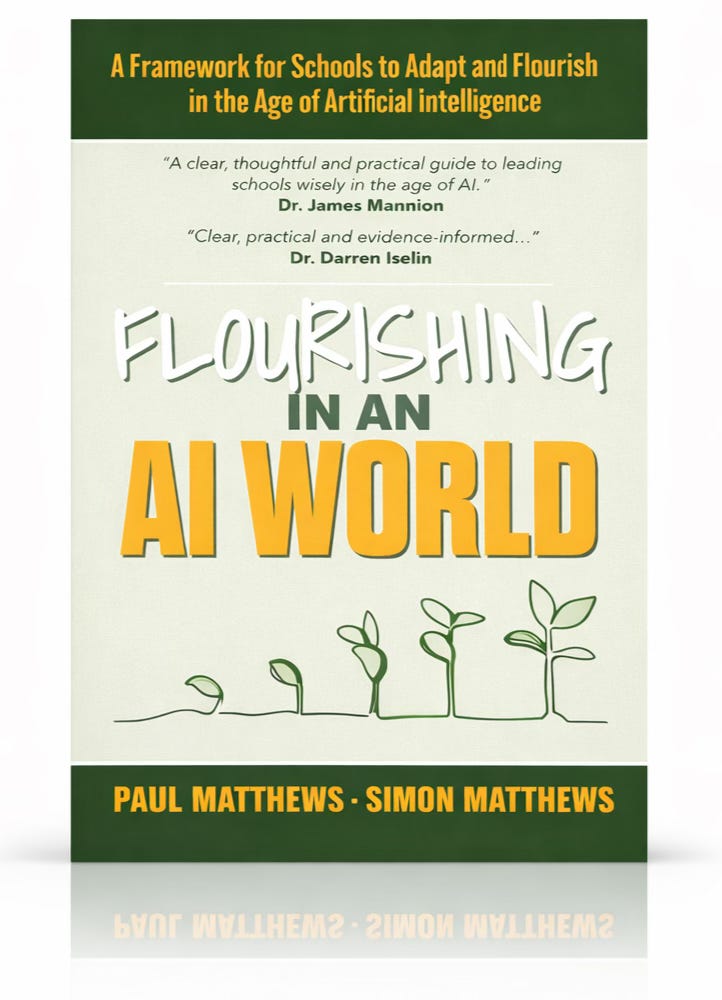
Just a quick note to say that my new book launched last week!
It’s a simple, evidence-based framework to help schools navigate AI. Rather than a one-size-fits-all approach, it’s a tool that helps a school take stock of their situation, develop a strategic priority, pilot the solution, then scale and sustain the result.
I’ll write about it more in the future, but if that sounds like something you’d be interested in, why not give it a look?
Happy teaching!
The article says to research… to search different avenues. Where ???
It does sound confident, doesn't it? So important that we teach students the realities of using AI.